What Is a Personal Skill Graph? (And Why Engineers Are Using One Instead of a Resume Skills Section)
A personal skill graph maps capabilities with depth, evidence, and connections. Here is why engineers use one instead of a flat résumé skills list.
Skill Graph Team••7 min read
You have probably seen the skills section at the bottom of a résumé: a comma-separated list of technologies, frameworks, and buzzwords. Python, React, AWS, Docker, Agile. It sits there, doing almost nothing.
Recruiters skim it. ATS systems parse it. Nobody learns anything meaningful about what you can actually do.
A personal skill graph is the alternative. Instead of dumping skills into a flat list, you map them as a connected structure with depth levels, evidence, and relationships between skills. The result is a living document that shows what you know, how deep you know it, and what you should learn next.
What makes it a "graph"?
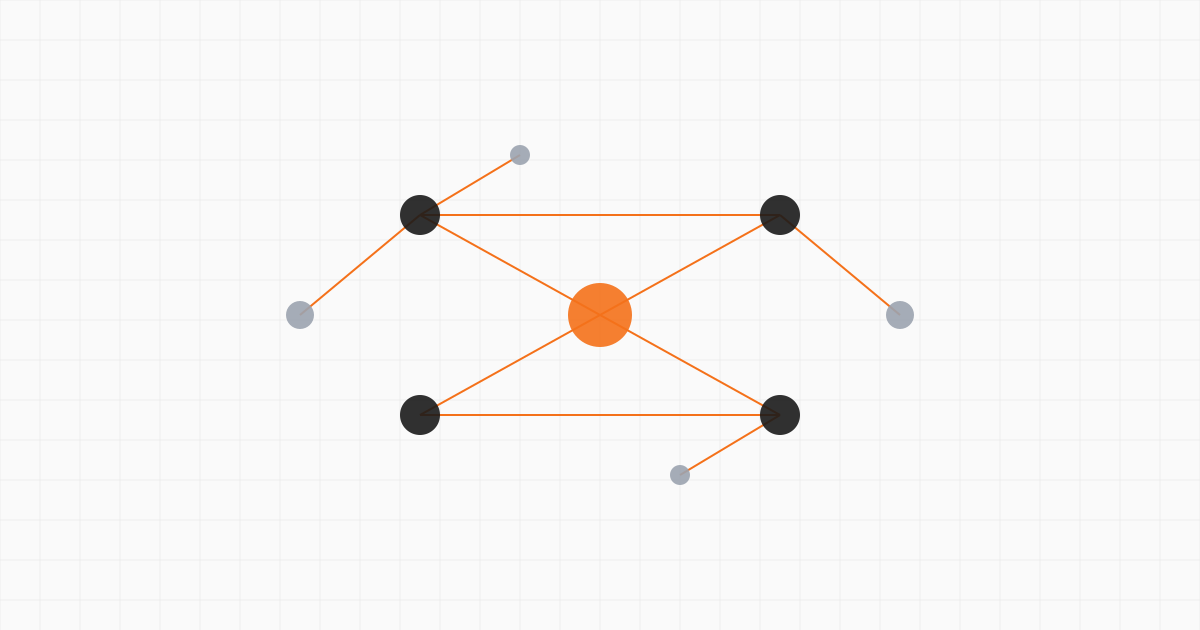
In the technical sense, a graph is a set of nodes connected by edges. In a personal skill graph:
Nodes are individual skills: Python, system design, data modelling, technical writing.
Edges are relationships between skills. Python connects to data engineering. Data engineering connects to pipeline design. Pipeline design connects to system design.
Depth levels indicate how advanced you are in each skill. Most graphs use a scale like exposure → working → proficient → expert.
This is fundamentally different from a list. A list says "I know Python and I know system design." A graph says "I know Python at expert depth, and I used it to build data pipelines, which required working-depth knowledge of system design. My evidence is a production pipeline processing 500K events per day."
The connections matter because they reveal transferable skills, hidden gaps, and the most efficient path from where you are to where you want to be.
Why the résumé skills section fails
The skills section on a traditional résumé has three structural problems:
Ready to map your competitive advantage?
Stop guessing your next move. Visualize your skills, identify gaps, and grow with AI-powered guidance.
1. No depth information. Listing "Kubernetes" beside "HTML" tells a recruiter nothing about whether you can architect a cluster or whether you once completed a tutorial. Both look the same.
2. No evidence. There is no mechanism to attach proof. Every claim is self-reported and unverifiable. TestGorilla's 2024 State of Skills-Based Hiring puts skills-based methods at 81% of employers, up from 57% in 2022. They still verify through tests and work samples, because résumé claims cannot be trusted on their own.
3. No relationships. Skills do not exist in isolation. React connects to JavaScript, which connects to TypeScript, which connects to frontend architecture. A flat list hides these connections, making it harder for you to plan growth and harder for a recruiter to assess how your skills fit together for a role.
A personal skill graph fixes all three. Each skill carries a depth level, links to evidence (a project, a pull request, a certification), and connects to related skills.
What a personal skill graph looks like in practice
Consider a mid-level backend engineer building their graph. Instead of the usual "Python, PostgreSQL, Docker, REST APIs, CI/CD" list on a résumé, the graph forces honest self-assessment:
Domain
Skill
Depth
Evidence
Backend
Python
Expert
Led migration from Flask to FastAPI, shipped internal SDK used by 3 teams
Backend
REST API design
Proficient
Designed and documented public API with 40+ endpoints
Data
PostgreSQL
Proficient
Optimised query performance, reduced P95 latency by 60%
Data
Data modelling
Working
Designed schema for analytics pipeline (mentor-reviewed)
DevOps
Docker
Proficient
Containerised 4 microservices, wrote Docker Compose setup for local dev
DevOps
CI/CD
Working
Configured GitHub Actions pipelines, but never managed production deployments independently
The moment this is laid out, the gap becomes obvious. Data modelling and CI/CD both sit at "working" when the roles this engineer is targeting need "proficient." That is not something visible from a résumé. The flat list makes everything look equal.
Now look at the connections: Python → REST API design → PostgreSQL → data modelling forms a coherent backend path. Docker → CI/CD forms a DevOps path. The graph shows deep backend skills but real weakness in DevOps.
That specificity changes how learning time gets spent. Instead of vaguely "getting better at DevOps," there is a concrete target: move CI/CD from working to proficient by owning a production deployment end-to-end within two months.
How engineers use them
Career planning
The most common use case is gap analysis. You overlay your current graph against the requirements of a target role (pulled from 3-5 job descriptions) and mark the mismatches:
Missing skills: not in your graph at all.
Depth gaps: in your graph, but at a lower depth than the role requires.
Evidence gaps: you believe you have the skill, but you have no proof.
This replaces "I should probably learn Kubernetes at some point" with "I need working-depth Kubernetes with evidence of deploying at least one production workload." That specificity changes behaviour.
Interview preparation
A skill graph maps directly onto competency-based interview questions. When an interviewer asks "Tell me about a time you designed a scalable system," you scan your graph, find the relevant skill node, and pull the attached evidence.
Engineers who prepare this way consistently report spending less time on generic practice questions and more time on targeted preparation where their evidence is strongest. Instead of rehearsing random STAR stories, they review their graph before each interview, identify the 3-4 nodes most relevant to the role, and prepare evidence narratives for those specifically. The prep is targeted rather than scattered.
Proving capability beyond the résumé
A résumé is constrained by format: one page, reverse-chronological, optimised for ATS keyword matching. A skill graph is not. It can show ten years of accumulated capability, track depth changes over time, and link to real work.
This matters especially for career changers. If you move from mechanical engineering to software, your résumé shows a gap. Your skill graph shows that CAD → 3D modelling → computational geometry → Python scripting is a connected path. The skills transferred. The résumé just cannot show it.
How a skill graph is different from a skills matrix
You may have seen skills matrices in corporate settings: a spreadsheet with names on one axis and skills on the other, filled with red/amber/green ratings. Every company with more than 50 engineers seems to have one, and almost nobody finds them useful.
The core problem is ownership. A skills matrix belongs to a manager or HR team. It gets updated during annual reviews (maybe), it uses whatever scale the company decided on, and it serves the organisation's resource-planning needs, not your career needs. Many engineers find that their skills matrix lists technologies the team stopped using a year earlier. Nobody notices.
A personal skill graph reverses this:
You own it. It updates when you update it, not during annual review cycles.
It has structure. Skills are connected, not isolated cells in a spreadsheet. This reveals which skills unlock others and where compound growth is possible.
Evidence is attached. Instead of a traffic-light rating from your manager, each skill links to the work that proves it.
It travels with you. When you change jobs, your skills matrix stays behind. Your graph comes with you.
How to build one
The fastest way to start is how to build a skill graph from a CV. Upload a CV, extract skills, group them into domains, and assign initial depth levels from the experience descriptions. From there you refine, add evidence, and connect related skills.
If you prefer a manual approach, the step-by-step guide walks through the process: listing skills, grouping them into domains, assigning depth levels, attaching evidence, and identifying gaps.
Either way, the goal is the same: replace the flat skills list with a structure that actually shows what you can do.
FAQ
Is a personal skill graph a replacement for a résumé?
No. A skill graph complements a résumé, it does not replace it. The longer format comparison is resume vs portfolio vs skill graph. You still need a résumé for ATS systems and initial screening. But the graph is the verified source of truth behind the résumé. It makes every bullet point stronger because you know exactly what evidence supports each claim.
How long does it take to build?
Most engineers build a first version in 15-20 minutes using the CV workflow. Refining evidence and depth levels takes another hour spread over a week as you recall specific projects and outcomes.
How often should it be updated?
Monthly is a good cadence. After completing a project, passing a certification, or learning a new tool, update the relevant nodes. Over time, the history of depth changes tells a growth story that is powerful in promotion discussions and interviews.
What if there is no formal evidence for a skill?
Not all evidence needs to be formal. A side project, an internal document, a code review, or a meaningful contribution to a team discussion all count. The point is to anchor each skill to something concrete rather than leaving it as a self-assessed claim.